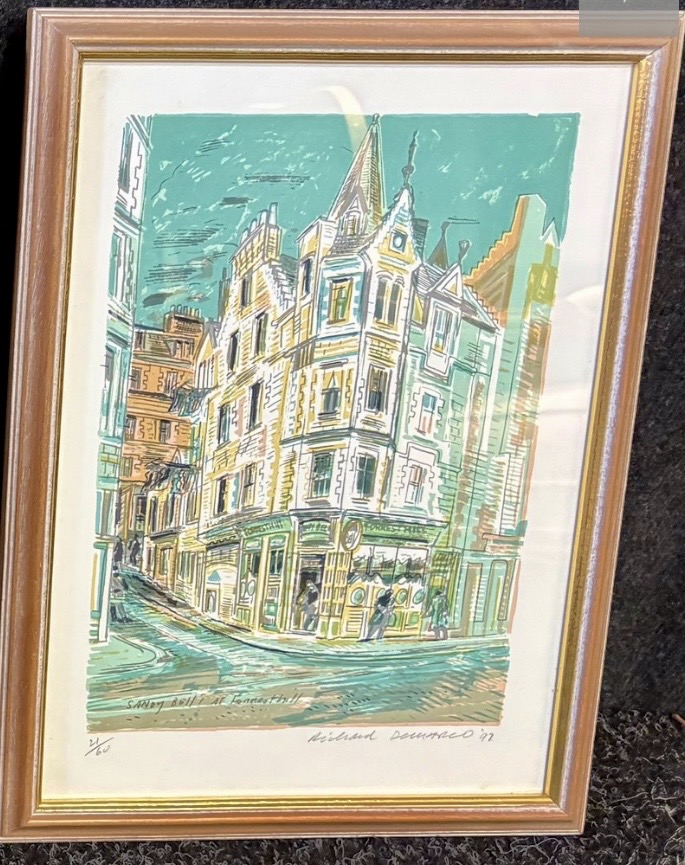
Professor Richard Demarco CBE, HRSA, RSW, FRSA) (b.1930), Scottish
Sandy Bells at Forrest Hill, limited edition, 21/60, 1992
£1.00
Out of stock
“This is another painting by Joe Hendry exploring the theme of the kilted Scottish figure. The man is shown from behind, hands clasped behind his back, standing quite calmly on the canvas.
What I like about this one is its simplicity. There’s nothing complicated about it — just a figure, a kilt, and a quiet bit of attitude. Hendry manages to make something very Scottish feel fresh and contemporary at the same time.”
Richard Demarco CBE (born 9 July 1930) is a Scottish artist, educator and one of the most influential promoters of contemporary art in Scotland. He was born in Edinburgh to a Scottish-Italian family and grew up in Portobello, where his family ran a café.
Demarco studied at Edinburgh College of Art, where he trained in book illustration, typography, printmaking and mural painting. After completing his studies he worked as an art teacher at Scotus Academy in Edinburgh during the late 1950s and early 1960s.
In 1963 Demarco became a co-founder of the Traverse Theatre, an important venue for experimental theatre and contemporary art in Edinburgh. A few years later, in 1966, he established the Richard Demarco Gallery, which became a key platform for international contemporary art during the Edinburgh Festival.
Through the gallery and related projects, Demarco helped introduce major European avant-garde artists to Scotland, including Joseph Beuys, Marina Abramović, Paul Neagu and Tadeusz Kantor, creating important cultural links between Scotland and continental Europe during the Cold War period.
Alongside his work as a cultural organiser, Demarco has maintained a personal practice as an artist, producing drawings, watercolours and prints, and his work has been exhibited in institutions including the Royal Scottish Academy.
In recognition of his contribution to the arts he has received numerous honours, including appointment as Commander of the Order of the British Empire (CBE) in 2006.
Today Demarco is widely regarded as a central figure in the cultural life of Edinburgh and the wider European art world, particularly for his role in connecting Scottish art with international avant-garde movements.